

Pull up your software inventory and sort it by what each product actually does. A few platforms run the business. Around them sits a ring of smaller subscriptions whose whole job is connecting the big ones. An integration suite. A document-processing tool. Something that moves data from A to B because A and B were never properly introduced.
Each of those purchases made sense on the day it was signed. There was a gap, the platform couldn't fill it, and a vendor could. Nobody did anything wrong.
But two things have moved since. The platforms grew, because absorbing adjacent capability is what platforms do. Azure picked up integration services, GitHub picked up security scanning, your ERP grew an API worth using. And the one job platforms still couldn't do out of the box, the genuinely awkward one, was interpretation. Reading input that arrives in whatever shape a partner felt like sending. Mapping one system's idea of an order onto another's. Working out that "next Tuesday", typed into a portal by a human, is a delivery date.
Interpretation is what the specialist products were really selling. It also happens to be the thing a language model is good at. So the gap that justified those renewals has closed. The invoices haven't noticed yet.
The case in four lines
The build itself is simple to describe. Azure AI Foundry sits between your systems, receives a payload, knows the target schema, and produces the mapped output. Proving that takes a workshop, and the demo is impressive. What convinces a CFO is different.
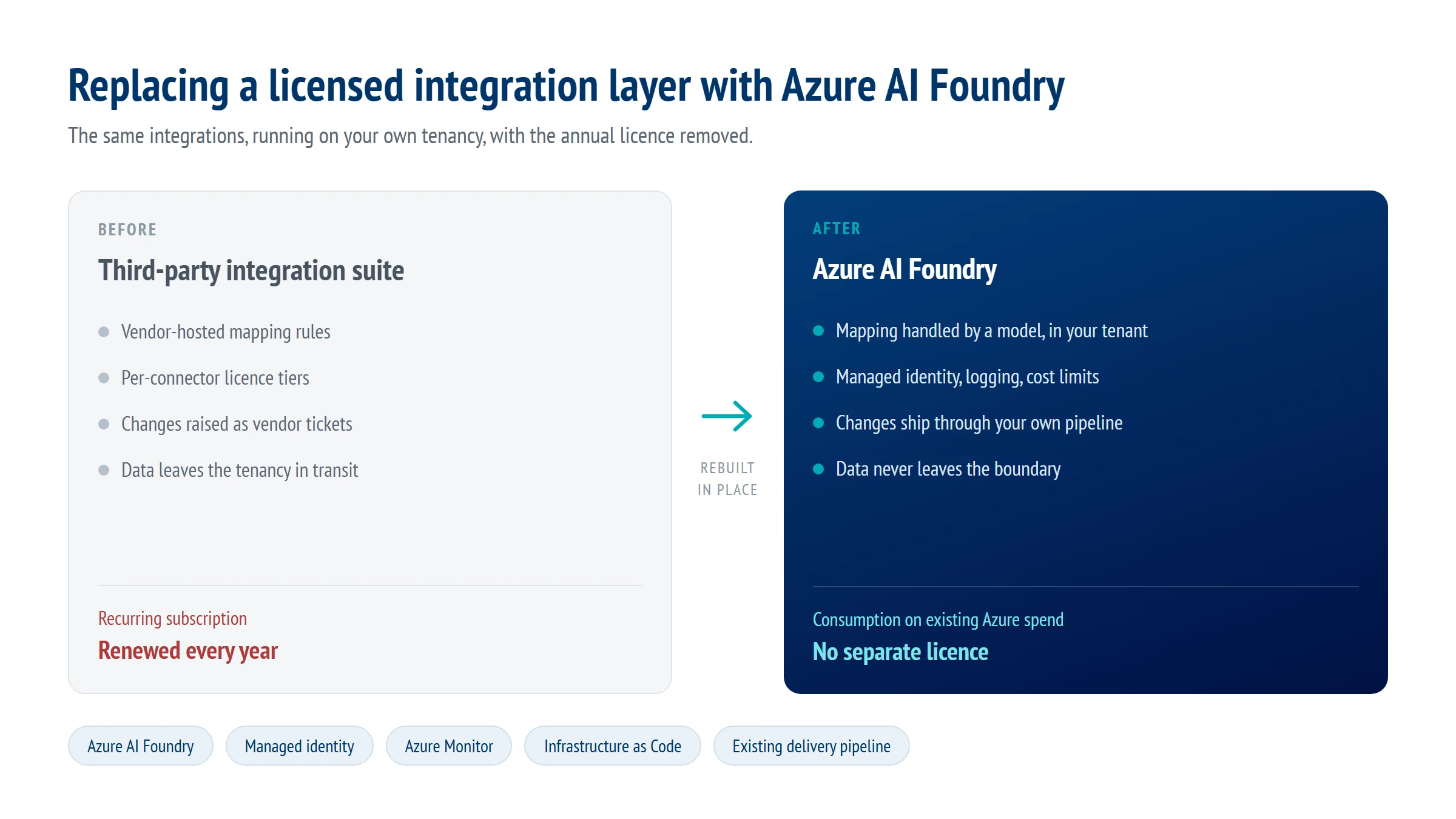
The licence stops. In its place you pay consumption, billed as ordinary Azure spend. If you have a Microsoft Azure Consumption Commitment, Foundry usage counts toward it. The spend moves onto an agreement you already negotiated, and usually shrinks on the way.
Changes come home. Mapping logic becomes code in your repository. When a partner changes a format, your team edits it and ships the fix through the same pipeline as everything else. No vendor ticket, no waiting for someone else's release window.
Data stops commuting. Payloads no longer round-trip through vendor infrastructure. That shortens every security review and settles most sovereignty questions before anyone asks them.
Governance stays yours. Managed identity, Azure Policy, Azure Monitor, and a hard budget cap on the Foundry resource. The same controls as the rest of your estate, rather than a vendor trust page you take on faith.
Which renewals to question
A candidate product has a particular smell. Its value sits in rules that accumulated over years: mappings, templates, translations, parsing logic. Ask what a rebuild would take and the honest answer used to be years of edge cases, rediscovered one incident at a time. A model changes that answer, because handling messy input no longer means hand-writing a rule for every variation somebody's portal can produce.
Leave your systems of record alone. Same for anything whose value is a network, since nobody should rebuild a payment scheme, and for products carrying certifications you'd otherwise have to earn yourself. The target is the connective tissue: software that interprets, reformats and forwards.
Prove it before you cancel anything
Run old and new side by side on live traffic, and compare outputs until the numbers convince you rather than the demo. Validate every mapped result against the target schema, and send anything that fails to a queue a person reviews. A model that stops loudly is useful. One that's confidently wrong is how you corrupt an order book.
Keep the deterministic paths as plain code while you're at it. Where a rule is known and stable, code is faster, cheaper and easier to audit than any model. Foundry earns its keep on the long tail, where the rules were never written down.
And count all of it: model consumption, the engineering for validation and fallbacks, the ownership you're taking on. None of this makes AI free. It makes the capability yours, running under your identity model, your budget caps and your monitoring, on infrastructure you already govern.
That's the whole argument. Fewer products, more leverage from the platforms you keep, and a renewal that turns into capability your own team controls.
There's no one-size-fits-all approach to the cloud. That's why we meet you where you are.